Thursday, 31 October 2013

What is Psychogeography take 2...

http://teatowelsandsheets.wordpress.com/2011/01/25/what-is-psychogeography-my-attempt-to-explain/

‘…reflecting a wider awareness of ‘spirit of place’ through which landscape, whether urban or rural, can be imbued with a sense of the histories of previous inhabitants and the events that have been played out against them…This visionary continuity is described as a ‘chronological resonance’ and is the point at which place, history and identity converge…’
This was a quote I found from a woman describing her own opinion on what psychogeography is.


This is something that has can be interpreted differently depending on how you look at it, It is a wide set of views and ideas, this is some of the points I found important to my own understanding of what psychogeography is:

  • Psychogeography approaches can be used as a playful tool to connect people to their environments more
  • Mixture of psychology and geography
  • Effect of the geographical environment on individual behaviour
  • Importance on the activity of walking to enable a slow movement through surroundings
  • The activity of walking becomes a subversion its-self, from our fast paced lives, as it goes against the spirit of the modern city
  • exploring and analysing areas of the environment that have become overlooked
  • New ways of experiencing surroundings instead of the drab monotony of everyday travel and well known routes
  • Reveal the true nature of a place below the flux of everyday life
  • sense of place
  • Engagement is part of being human
  • Rimbaud's coining of the verb 'Robinsonner' to explain ideas of drawing mental maps
  • There is the political radicalism aspect of psychogeography but these are the points I am particularly interested in investigating.

Mexico Gallery...

I enjoyed this exhibition, I was particularly interested in how the artist were going to display their work as I am interested in using video within my own work.  I was also looking for some inspiration on experimental video for the subversive stitch video I am making.
The audience were encouraged to get under the blanket and put head phones on (two sets so only two people at a time) A half an hour long video was then played. I liked the involvement of the audience, this approach enabled the artist to position the viewer exactly where they wanted, viewer was close to the screen and sat down, this must have been the intention and I expect this had an impact on how this exhibit was digested. 

What I liked about this piece was the set up. there was two projections being displayed one one clean backdrop. I felt this was visually exciting and interesting although I didn't feel that this piece captivated my attention as much as some of the other exhibits

This piece was displayed in a small cornered off section making it quite dark and secluded. There was nothing but the audience, white walls and the projector. The video was just a projection of text, the background stayed the same. At first I was apprehensions as it wasn't visually enticing but the atmosphere it was displayed in was important. After watching the video twice I understood the content was of a 'secretive nature' and the dominance was just in the text, I did feel that this worked really well, but if the visuals are minimum there is more of an importance to get the environment correct. 

This was my favourite exhibit in this exhibition. I was already interested in the use of voices within video work as I think it often works really way as a tool to keep the audience interested. This video had a beautiful, slow, calm woman's voice talking as the video was playing. It wasn't so much the content of what she was saying but the clarity and beauty of the voice its self that I found was really effective. 
This Piece was exhibited in a large space, large projection and room for the viewer to sit down and lean against the adjacent wall. It was a comfortable environment which I felt also enticed the viewer to watch the hole video (13 minutes) 
The video its self was beautiful,
 I loved the use of light and projection within a setting we can all relate to 
this is definitely a point I will remember when I am making my videos for my work and also for the Subversive Stitch conference, I feel this approach could be really effective in creating something experimental, coherent and interesting at the same time. 

Tuesday, 29 October 2013

The Slow Movement...

The Slow Movement


For fast acting relief, try slowing down.
                    ~ Lily Tomlin, Comedienne

Anything worth doing is worth doing slowly.
                    ~ Mae West, Actress

We are living the fast life, instead of the good life.
                    ~ Carl HonorĂ©, author of In Praise of Slowness


The Slow Movement is a term describing a wide range of efforts taking place around the world that seek to connect us more meaningfully with others, with place, and with ourselves. It emerged as an effort to counteract the fast–paced, commodity–focused, unbalanced, and impersonal nature of much of modern human culture. The main tenant of the Slow Movement is that by taking the appropriate amount of time to experience the various activities of our lives, we are able to get in touch with what is deeply satisfying and fulfilling. 

We live a fast paced lifestyle, people used to be so much more connected to their families and to their surroundings, now we don't have time to make theses connections and we still crave them. We try to pack as much as we can into life, rushing around, using cars and trains instead of walking, wolfing our food down instead of taking time to cook and enjoy it, not having the time to enjoy the outside world and take inspiration from it,
I want to give people the opportunity to enjoy their surroundings in nature if only for a short period of time, but hopefully this will enable people to think more about taking some time to life a little slower. 

Monday, 28 October 2013

Nature Deficit Disorder...


'We are torn between two worlds one of beauty and one of commerce'

Health benefits of spending time outside:
  • Your vitamin D levels rise. Sunlight hitting the skin begins a process that leads to the creation and activation of vitamin D. Studies suggest that this vitamin helps fight certain conditions, from osteoporosis and cancer to depression and heart attacks. Limited sun exposure (don’t overdo it), supplemented with vitamin D pills if necessary, is a good regimen.
  • You’ll get more exercise. If you make getting outside a goal, that should mean less time in front of the television and computer and more time walking and doing other things that put the body in motion.
  • You’ll be happier. Light tends to elevate people’s mood, and there’s usually more light available outside than in. Physical activity has been shown to help people relax and cheer up, so if being outside replaces inactive pursuits with active ones, it might also mean more smiles.
  • Your concentration will improve. Children with ADHD seem to focus better after being outdoors. It might be a stretch to say that applies to adults, but if you have trouble concentrating, outdoor activity may help.
  • You may heal faster. In one study, people recovering from spinal surgery experienced less pain and stress and took fewer pain medications when they were exposed to natural light. An older study showed that the view out the window (trees vs. a brick wall) helped recovery in the hospital.

Unknown (2010). Harvard Health Letter. A prescription for better health: go alfresco30(4), 12.
I started looking at this topic of discussion as I am interested in getting people to interact with the outside environment more rather than being stuck inside. There are many health benefits related to spending time outside but I have come to realise it is not the health benefits of being outside which is driving my project, specifically I am interested in the rise of technology dependence.

I want to create encourage people to connect physically with there surroundings because this is part of being human and our fast paces lives and dependence on technology are hindering this flow of life. 

Big Data...


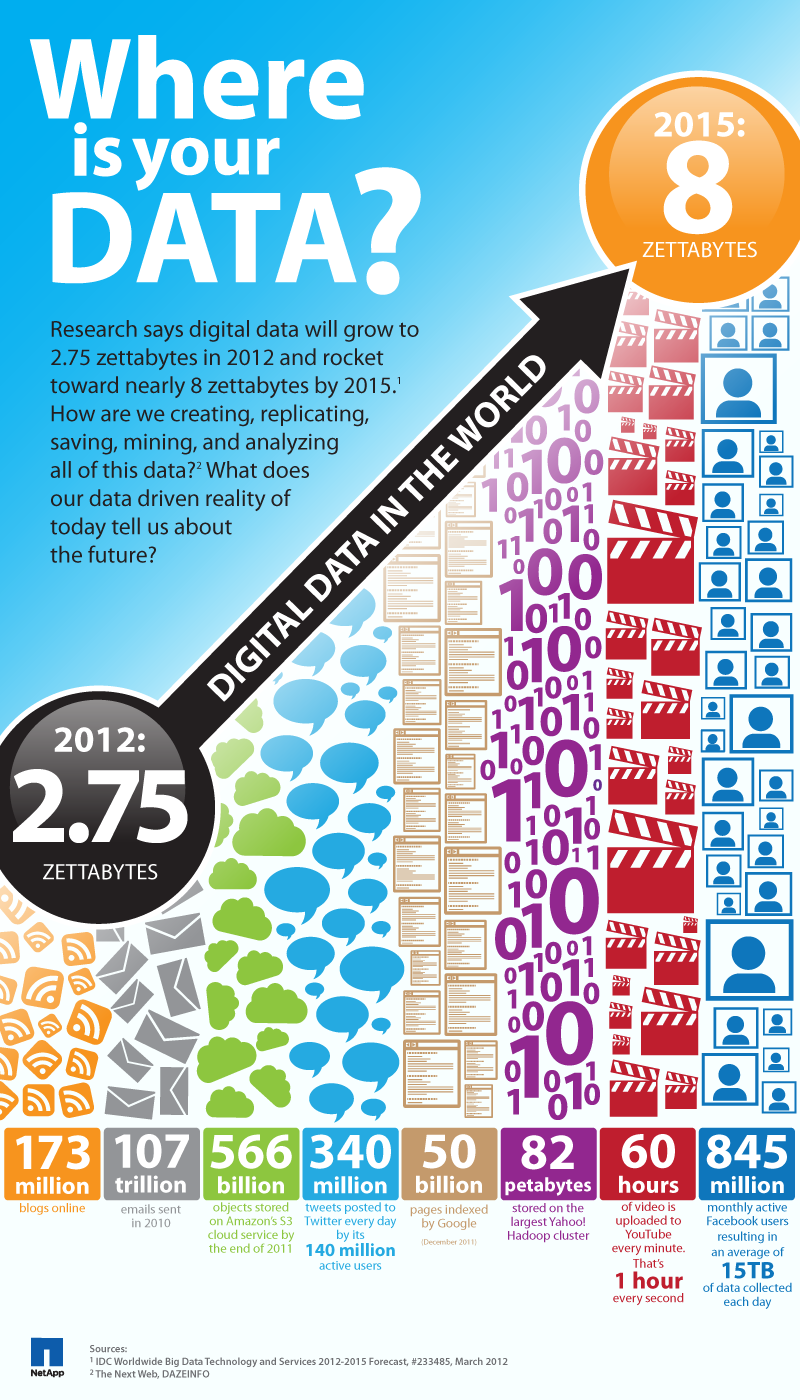
There is so much data stored and available now.
Everything we do is tracked and stored somewhere and data statistics are widely available to everyone online.

This big data is growing massively, there are many artists such as Eric Fischer who tap into these statistics to create artwork that illustrates how we are becoming technologically reliant, is this a bad thing or just a different way of living?
This also has a massive impact on our privacy, is anything truly private any more?

I started researching this topic through the work of Eric Fischer as  I was wondering where he could have collected his data from and why he chose maps to display this data.
I am also interested in the use of technology and how this effects our life these days, Are we becoming LOST in the virtual world and therefore this causes us to get LOST in the physical world?

Saturday, 26 October 2013

Aaron Sherwood...

Interactive installation, I was looking onto interactive installations that really captivate the audience's attention. This installation is amazing, It is like nothing I have seen before, When you move and push onto the stretched spandex the pitch and speed of the music changes, this was definitely captivating for me as I watched the video many times!

http://aaron-sherwood.com/works.html
I am really enjoying researching into alternate use of senses through technology but I feel like me next step is to get some more first hand experience of interactive installation and submersive settings, to fully understand being in the situation rather than through the internet or talking to other people about their accounts.

I also need to question what it is exactly that I want to achieve within my own project, from taking inspiration from this type of installation? (comprehensible answer coming soon!)

music glove

http://www.youtube.com/watch?v=6btFObRRD9k

This video shows Imogen using 'music gloves' She uses the gloves to play different noises, record, repeat, loop, chain and more, it is amazing how much she can change by moving her gloves into different positions, changing her voice, adding layers to create a really full bodied sound. I have no idea how she could have made these gloves but it is a fantastic video to watch. she describes what she is doing as 'mapping', instead of playing instruments she is 'mapping in 3d space' It is fantastic! she does describe that she was 'taken over' by the gloves and spends a lot of time using them.

Although this research doesn't directly link to what I am looking into, and I am not intending to attempt to make anything like this, but I found it a fascinating example of using alternative senses, movement to make sound in this way.


Subversive Stitch Video...

I was asked to make a 5-6 minute video about the sleeping bag project, to be shown at the V&A conference on the 29th-30th November. 
This includes filming, editing, thinking of a concept! compiling and creating. 
There is no set rules for the video, it is my interpretation of what I feel is important to include. This is an exciting prospect as I can create the video in my own style and also include what I feel is important (aslong as the people included are happy)
I need to put a lot of time aside to do this video properly, Managing my time is even more important.

Ideas:
Content- I started by brain storming facts and a story line to the sleeping bag project as I felt it was important to learn more before I started, 

I then started filming a discussion between a group of people who had been involved in the sleeping bag project, including Claire Barber and Rowan Bailey.
It was quite challenging filming a conversation on two cameras when I am only one person! I chose to have one camera on a tripod and the other hand held, thinking about where I was standing and which camera footage I wanted to use at one time i,e I can't use the long shot footage if I am in the frame! 

These cameras were nice to use and produce good quality HD video, also recorded audio on a Dictaphone to make sure the quality was good enough. I found the conversation interesting and I was aware I had a large volume of discussion footage.
Uploading the footage to the video editing computer in the print Bureau was great, I have only edited on my little lap top before so it was a lot easier having 3 large screens. I got some additional footage and photos from Claire, of the different phases of the project.
Looking at the footage I decided I wanted to start with the audio, Listen back through the conversations and mark out which bits of talking I felt were most important:


I have set aside 3 hours on a Friday morning to be put aside to work on the video, but this Friday I ended up marking the audio all day, this was inevitable as there was 3 hours of audio anyway and the only way to sort out what I wanted to include is to listen to it!
another few hours and the audio will be complete and hopefully I can fit everything I need into 5 minutes! Then I can start developing my ideas for the video.

This project is important to me, I feel that it is for a great cause so I want to do it justice, also it is for the V&A and that is a big opportunity and it will be a great achievement if I can do it justice, the problem is the time scale as I also have my own project hand in on the 25th of November.

I may need to ask for some help from a film student to finish the video.
This project will also benefit my video making skills, this will come in handy in my current project and also in my final project and in the future.

Thinking about the video:

 I think including some time lapse video could work well. I know a lady called Silva that is often sitting by the train station, she has to stay on the streets half the time at the moment so maybe she would be interested in letting me film her for a while.
I want to have a strong materiality to this video, using fades and overlays, I feel it is important to show the actual sleeping bags being used is I am also going to film people getting in and out of the bags.
Another important aspect is the start and end, I haven't thought of how I want to do this yet. 
New ideas:
  • Project video onto an outside space (somewhere homeless people may have to sleep) video this as final video?
  • time lapse photography of homeless people on the street.
12/11

I tried time lapse but decided to include video from a distance instead as it gave a different feel to the video with slow moving video rather than static images. 


The audio is all finished and I am working on fitting the video to the audio, and creating the right aesthetic by layering images. the most important aspects are Giving, Touch and Care.

Content:
  •  I wanted an introduction to the project,
  • Images of people talking, giving the video perspective,
  • hand gesturing,
  • strong images and a feeling of touch and fabric. 
  • context, need,
  • community aspect,
  • I chose to film homeless people from a distance, I wanted to include this to illustrate the need for kindness as well as warmth,
  • The distance was also so it wasn't too intrusive, showing ideas that homeless people are often overlooked. The video is not about the obviousness of helping it is about the selfless act of giving.  this is very important to the videos feel.
Here are some video stills:


TO DO
  • For the last part of the video it was suggested that I brought in my interaction with homeless people, as this was how I chose to engage with the project. I thought about how I could film this interaction, I really didn't want to include giving something to a homeless person as this would undermine the point of the video. I thought about a conversation but this is still too staged and obvious. I ended up asking people around town 'what it the act of gifting' It was interesting how everyone answered differently but I still think this approach is too stages and is very different from the rest of the video, so I wont be using this either. I think the best line of action for this section is to run with my initial idea of projecting onto an outside space and video this.
This is a test of this idea, but it will be outside:


Wednesday, 23 October 2013

How people touch the world through their shoes...

Different people touch the world differently, this can be seen from the bottom of a shoe.